



The conservative management of distal lesions in horses represents a daily challenge for the equine veterinarian and the equine practitioner, especially when critical structures such as flexor tendons, synovial sheaths, or the nail capsule are involved and surgery is not feasible because of clinical, prognostic, or economic reasons.
In these cases, the clinician's goal is to develop therapeutic protocols capable of controlling inflammation, reducing the risk of infection and supporting effective tissue repair, despite acting in a biologically unfavourable context.
A recent publication in Large Animal Review (2025), titled “High-power Photobiomodulation Therapy in the Conservative Management of Two Severe Equine Distal Limb Injuries”, offers new insights into the integration of high-power equine laser therapy within multimodal conservative protocols.
Veterinary laser therapy in horses: why consider it for non-surgical cases
In recent years, photobiomodulation in veterinary medicine has attracted growing interest as a supportive therapy for musculoskeletal disorders and soft tissue injuries.
In horses, however, the application of laser therapy in distal trauma remains less well documented, particularly in complex cases involving:
- complete tendon tears
- synovial contamination
- nail wall avulsions with bone exposure
The present study describes two severe equine clinical cases, both characterised by:
- initial prognosis from guarded to unfavourable
- impossibility of surgical treatment
- early introduction of MLS® Laser Therapy as an integral part of conservative management
First case: complete flexor tendon tear in horses
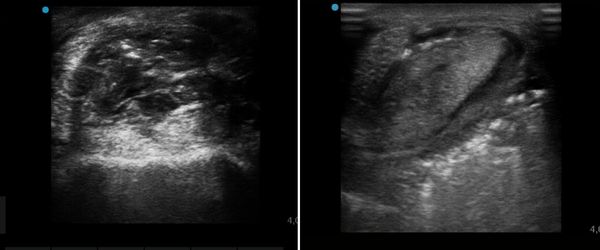
Conservative management with laser therapy
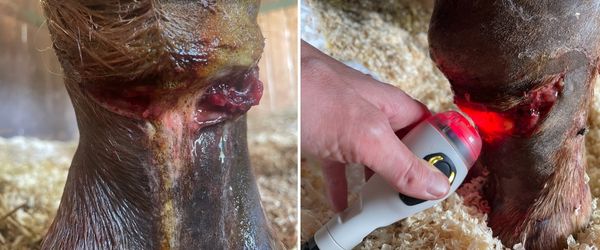
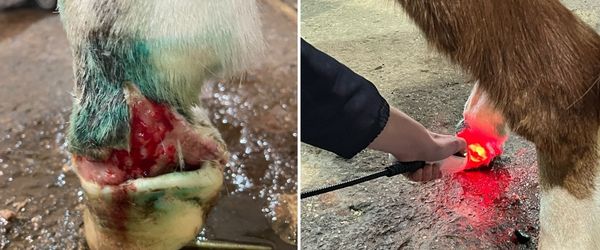
A 7-year-old performance horse presented with a complete tear of the superficial (SDFT) and deep (DDFT) digital flexor tendon at the level of the digital flexor sheath, a condition known to carry a poor prognosis without surgical repair.
Conservative management included:
- systemic and regional antibiotic therapy
- anti-inflammatory treatment
- prolonged external immobilisation
- 30 MLS® laser sessions spread over 123 days
Significant clinical results
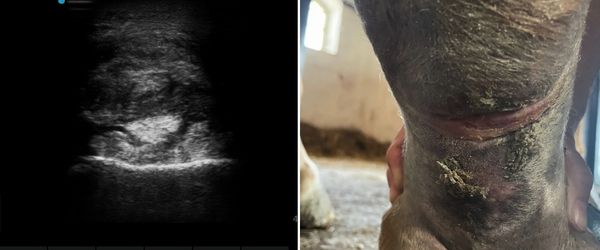
From the equine practitioner's perspective, the most significant aspects were:
- complete wound closure in approximately 60 days
- no infection, dehiscence, or exuberant granulation
- progressive tendon reorganisation documented by ultrasound
- functional recovery with return to controlled movement in the paddock
In a clinical context in which complete flexor tears with synovial involvement are often associated with significant complications, the quality of the repaired tissue is a particularly interesting aspect.
Case two: nail wall avulsion in a horse
PBM and distal wound healing
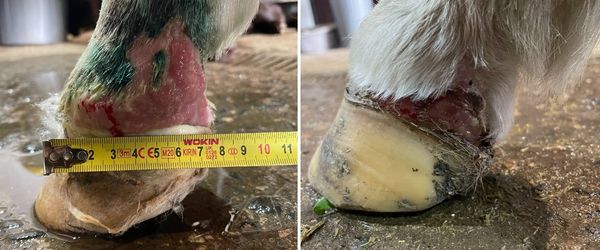
The second case involves a 5-year-old Shetland pony with traumatic avulsion of the medial nail wall and exposure of the distal phalanx (P3), a lesion frequently associated with:
- slow healing
- secondary infections
- formation of poor-quality scar tissue
The conservative protocol included:
- regular debridement and dressings
- systemic medical therapy
- 35 consecutive daily sessions of MLS® Laser Therapy
Healing progress
During the laser treatment period, the following were noted:
- wound contraction of approximately 1 cm/week
- progressive reduction in lameness
- formation of regular and stable granulation tissue
A clinically significant finding was the slowed healing after discontinuation of laser therapy, along with hair regrowth limited to the laser-treated areas, suggesting a possible effect on the quality of the regenerated tissue.
High-power equine laser therapy: indications emerging from clinical practice
Although this is a case report, the study provides useful insights for daily veterinary practice:
- MLS® Laser Therapy may represent a valid biological support in the conservative management of distal lesions in horses
- the noted results are consistent with the known cellular mechanisms of photobiomodulation (modulation of inflammation, mitochondrial stimulation, collagen organisation)
- the early introduction of laser therapy appears to favour a more orderly healing trajectory
- photobiomodulation (PBM) does not replace standard therapies but can enhance their efficacy in complex clinical contexts
MLS® Laser: reasoned integration in equine clinical practice
This work reinforces a key concept for the equine veterinarian: MLS® Laser Therapy is not an alternative therapy, but an integrative tool, to be used consciously within structured conservative protocols.
For the equine practitioner, it means having an additional therapeutic alternative, supported by biological and clinical evidence, in cases where surgery is not feasible and conservative management is the only option.